Gold Just Beat the S&P 500 Over 30 Years: Here’s Why Gold Keeps Winning in Uncertain Times

Summary
- Gold Is Quietly Beating Stocks: Over the past 30 years, gold has delivered 8.82% annual returns, outperforming the S&P 500’s 8.22%, proving it’s more than just a defensive asset.
- Central Banks Are Buying: In 2025, central banks bought 863 tonnes of gold, pushing global demand above 5,000 tonnes as governments hedge against inflation, debt, and geopolitical risk.
- A Portfolio Shock Absorber: Gold often performs best when markets face uncertainty, acting as a store of value during inflation, currency weakness, and global instability.
- Physical Gold, Digitally: PAX Gold (PAXG) is backed 1:1 by real gold in LBMA vaults, allowing investors to own gold fractionally and trade it easily like crypto.
If you’ve ever felt like money doesn’t mean what it used to, you’re not imagining it.
Over the past few years, investors have had to deal with a reality that they simply have to face everything all at once: wars, trade disruptions, stubborn inflation, massive government debt, A.I and a global shift toward “strategic” economics — where politics and markets are tangled together.
In that kind of world, the boring assets quietly become the important ones. This is the reason gold keeps resurfacing, and not just in your uncle’s doomsday portfolio, but in close to every major central bank vault around the world.
In 2025, the World Gold Council reported that total gold demand topped 5,000 tonnes in a year that saw 53 new all-time highs in the gold price, with central banks alone buying 863 tonnes in 2025.
The rule is simple: never listen to what they say — watch what they do.
So what do these central banks see that most everyday investors don’t? Because central banks don’t buy gold for a quick trade, they buy it as a financial reserve asset.
What Actually Drives The Price of Gold?
Gold isn’t magic, it's more of a “macro mirror”: it reflects what investors feel about money, risk, and trust – understanding how gold reacts makes it easier to decide whether gold belongs in your portfolio.
Real Yields (Interest Rates Minus Inflation)
The relationship between gold and real yield states that gold does well when real yields fall, and gold does poorly when real yields rise.
This relationship makes sense once you take a closer look at the two things that determine real yield: government bond yields and inflation.
When bond yields rise, investors can earn more from government bonds, so the opportunity cost of holding gold goes up — because gold pays no interest. That can make gold less attractive and put downward pressure on its price.
But when inflation rises, the equation flips. Inflation erodes the real value of paper cash and the future payouts from bonds. In that environment, gold often looks more appealing as a long-term store of value — because it can’t be printed or diluted.
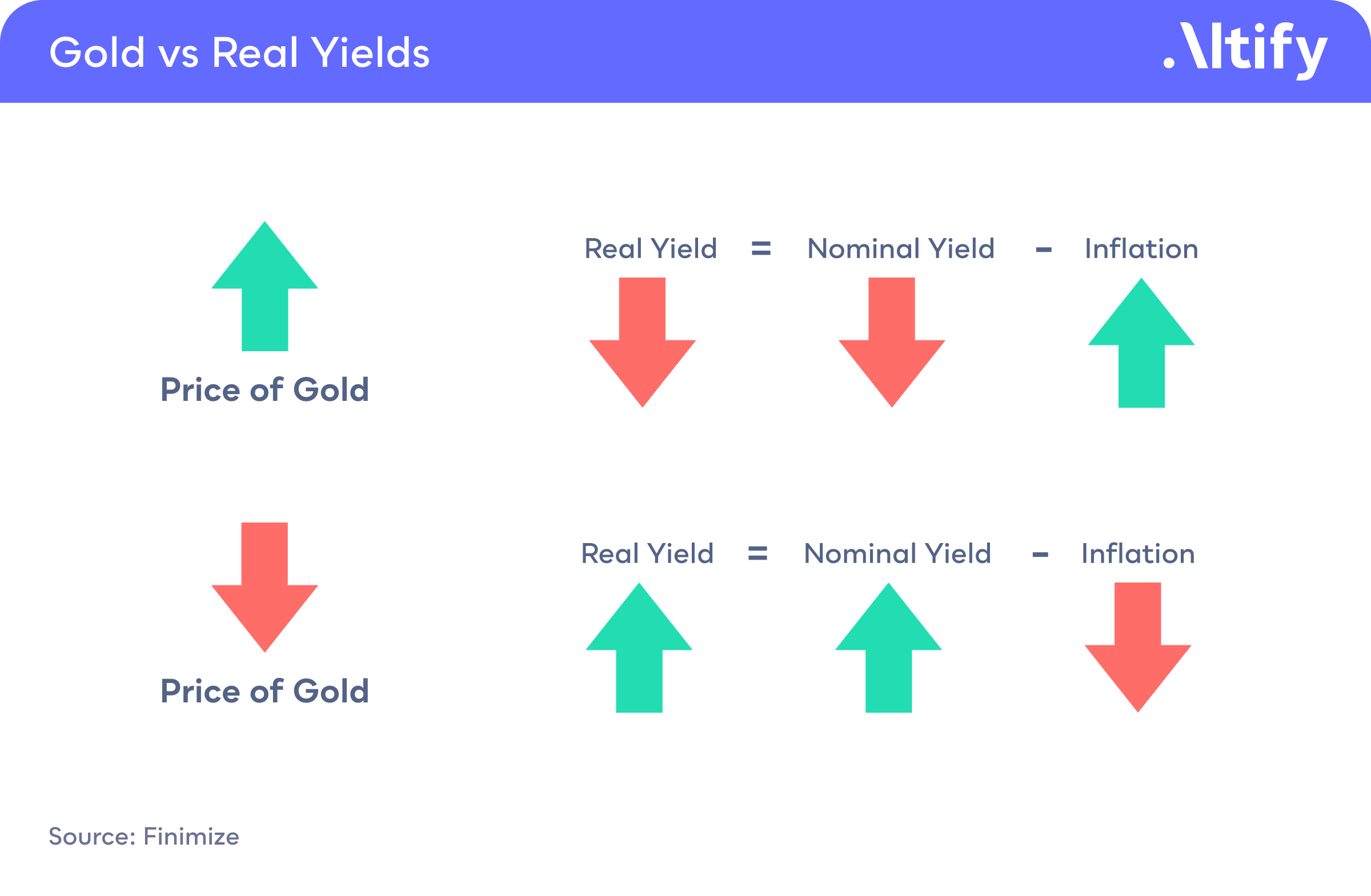
Most of the time, gold and real yields move in opposite directions — but not always. In recent times, and due to countries' large national debt levels, higher real yields driven by higher nominal yields can cause gold to rise. This is because of the increased risk that governments can't pay their interest on their debt, forcing them to create more money just to cover their expenses.
The U.S. Dollar
Gold is priced in U.S. dollars, so the dollar matters a lot.
When the dollar weakens, gold becomes cheaper for buyers outside of the U.S. This often boosts global demand and can push gold prices higher. A weak dollar can also nudge U.S. investors toward “hard assets” like gold as a store of value.
Most of the time, gold and the dollar move in opposite directions — but not always. In big risk-off moments, both can rise together because the dollar is also seen as a safe haven. When fear spikes, investors often buy both at the same time.
Investor Sentiment and Trust
When markets get shaky — geopolitics, banking stress, debt fears — investors tend to reach for assets that aren’t someone else’s liability. Gold has played that role for centuries.
Why Should Everyday Investors Care?
The reality is most retail portfolios are more fragile than they look. A typical “modern” portfolio leans heavily toward:
- Stocks (great when growth is stable)
- Property (great when rates are falling)
- and cash (which quietly loses purchasing power over time)
Gold’s role is different: it can be a portfolio shock absorber — an asset that can help when the world surprises you and your “modern” portfolio.

The above demonstrates gold's ability to absorb shocks and give positive returns in times where the stock market has seen some of its most prolific downturns.
Investors use Gold for 3 reasons:
- Diversification: Today's world is so uncertain, investors need gold more than ever because it doesn’t move in the same direction as other investments.
- Inflation Protection: With rising country debt levels around the world, monetary printing is growing at an exponential rate. This signifies long periods of currency debasement in which gold as a hard asset increases in value.
- Geopolitical Hedge: The world has hundreds of geopolitical mousetraps in 2026. From Taiwan and China to Russia and Iran, risk is everywhere. Gold has the best history of protecting value during war time.
If You Think Gold Doesn’t Make You Rich… You’re Wrong
A common rationale among everyday investors is, “gold is just a diversifier, it won’t make me rich” or “ its returns are too low, I need equities to make money”
This couldn't be further from the truth.
In fact, many would be shocked to know that gold has actually outperformed the S&P 500 over the last 30 years.
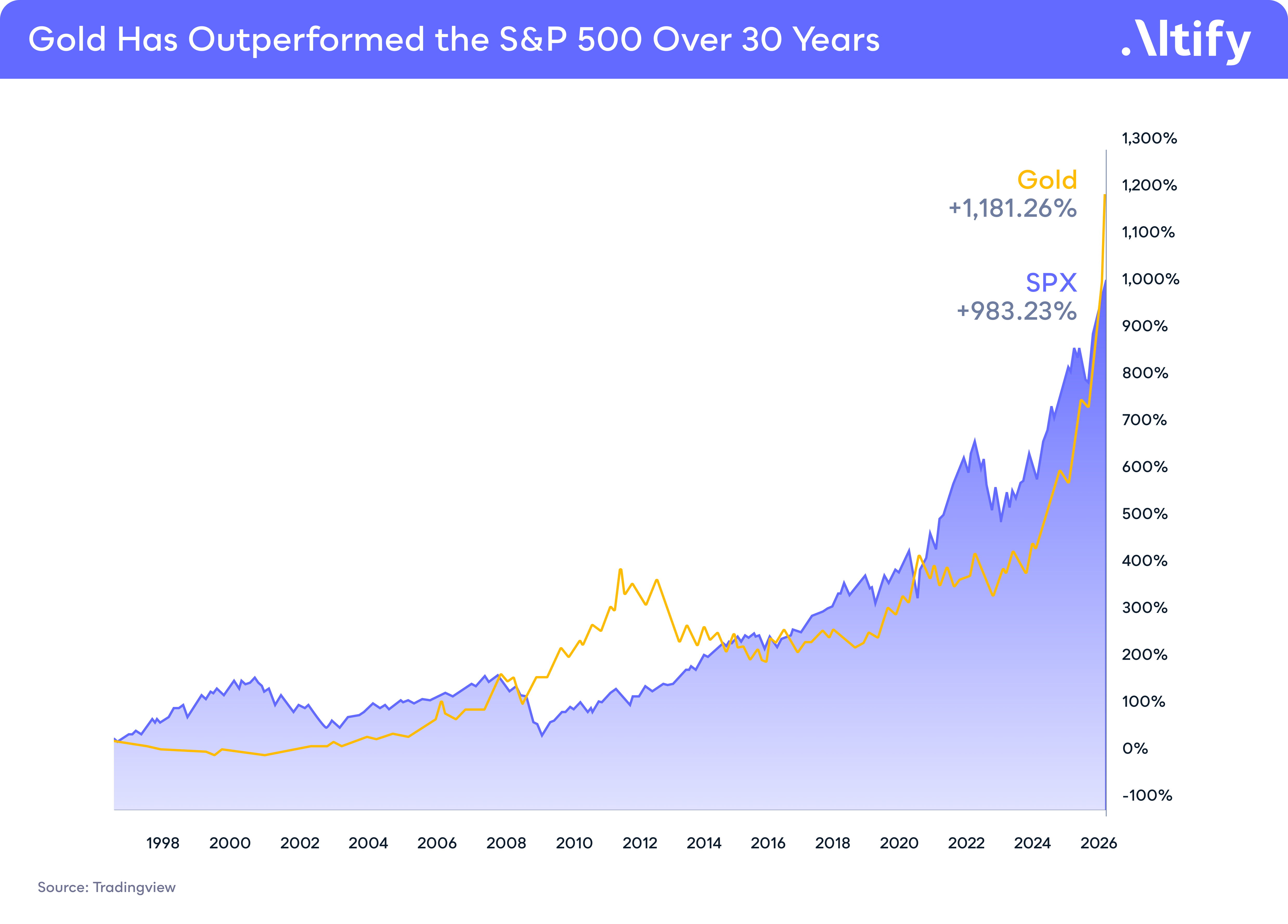
Since 1996, Gold has returned 8.82% per year while the S&P 500 has returned 8.22% per year. This means that not only is gold one of the best diversification assets of all time, it's also one of the highest returning – a true portfolio must own.
The Problem With Gold is The “Owning it” Part
Most people like the idea of gold until they try to buy it. Physical gold comes with real-world friction:
- Storage,
- Insurance,
- Security risk,
- Hassle of selling quickly at a fair price.
Yes, ETFs are easier — but you’re relying on fund structures, trading hours, and ongoing fees.
So what if you could own gold like a crypto asset — fractional, transferable, and easy to hold?
Enter PAX Gold (PAXG): Physical Gold With Modern Tech
PAX Gold (PAXG) is a tokenised gold asset where 1 PAXG token is backed by 1 fine troy ounce of gold stored in London Bullion Market Association (LBMA) vaults.
If you own a PAXG token, you have the legal ownership right to the underlying physical gold, held in custody by U.S. regulated and insured trust company called Paxos.
The pitch is simple: You’re getting real gold exposure, with digital convenience.
Conveniences like:
- Buy fractions of an ounce (instead of needing a big lump sum).
- Hold it alongside your other digital investments.
- Trade without the physical storage and portability headaches.
Why You Should Consider PAXG Today
If you’re an everyday investor, the biggest advantage of PAXG isn’t that it’s flashy.
It’s that it’s practical.
When central banks buy gold, they’re not trying to “trade the chart.” They’re managing national risk.
PAXG gives you a retail-friendly way to take a page from that playbook — not by stockpiling bars in your house, but by owning gold exposure in a modern, liquid format.
If your portfolio is mostly growth assets, PAXG can be your stability hedge that has outperformed the S&P 500 over the past 30 years. It’s not a bet against the world, it’s a bet that uncertainty keeps showing up — because lately, it has.
Where Can You Buy PAX Gold (PAXG)?
Now you have a better understanding of the PAX Gold (PAXG), why not take the next step on your crypto journey?
At Altify, we make it easy for our users to purchase PAXG and other cryptocurrencies. Altify, has no sign up fees, and has minimum investment amounts as low as R150 with non lock-up periods, meaning you can sell your PAX Gold at any time 24/7/365.
Altify also offers 20+ cryptocurrencies, and 13 ETF-style Crypto Bundles which provide diversified exposure to the broader crypto market or niche crypto sectors through a single investment. Their Crypto Bundles automatically update every month ensuring your crypto holdings stay up to date with the fast moving crypto market.